Client Hub
A healthy, lush lawn benefits the environment. LEARN MORE


If your Minnesota lawn is thin, compacted, patchy, or struggling to recover from summer stress, aeration and overseeding can be two of the most effective ways to improve it.
But timing matters.
For lawns in Brainerd, Baxter, Nisswa, Crosslake, and the surrounding Brainerd Lakes Area, late summer into early fall is generally an excellent period for aerating and overseeding cool-season turf.
At JLC Turf Services, we use professional lawn aeration and overseeding to help homeowners develop thicker turf, stronger roots, and lawns that are better able to compete with weeds.
A lawn can gradually lose density even when it is being fertilized and maintained regularly.
Minnesota lawns deal with a combination of stresses throughout the year, including:
Compacted soil can be particularly troublesome because grass roots need more than fertilizer. They also need access to water, nutrients, and oxygen.
When soil becomes heavily compacted, developing the deep, healthy root system necessary for dense turf becomes more difficult.
That's where core aeration can help.
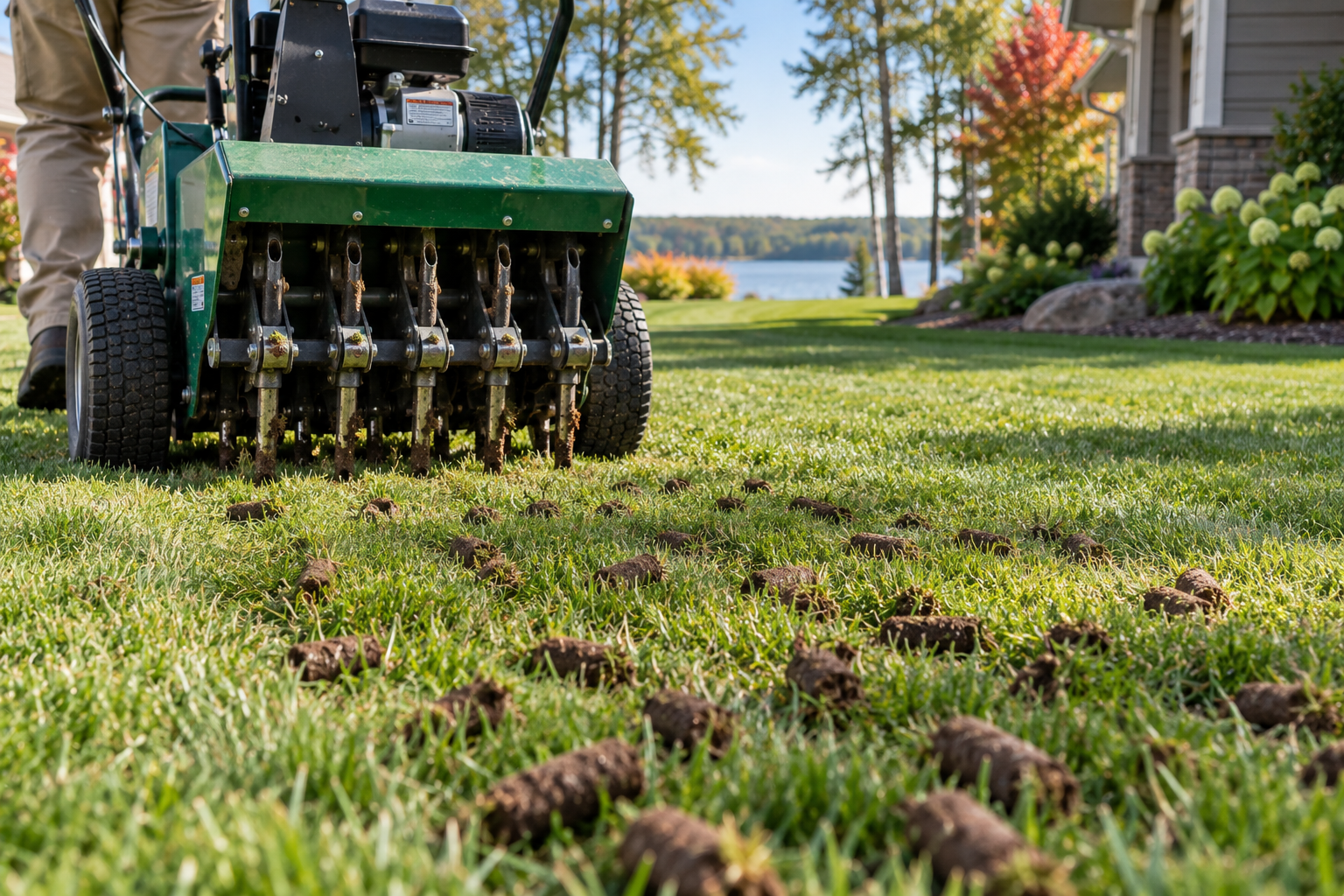
Core aeration mechanically removes small plugs or cores of soil from the lawn.
These openings help relieve compaction and create pathways for air, water, and nutrients to move into the soil and root zone.
Aeration can help:
Aeration isn't simply about putting holes in the lawn. The goal is to improve the environment in which the grass roots are growing.
A healthier root system helps create healthier turf above the soil.
Overseeding is the process of introducing new grass seed into an existing lawn without completely removing the existing turf.
Instead of starting the lawn over, new grass plants are established among the existing grass.
This can be particularly useful when a lawn has become thin or patchy but still has enough desirable turf to preserve.
Overseeding can help:
One of the most important benefits is density.
A thick lawn leaves less open space for weeds to establish.
Aeration and overseeding complement each other.
Simply spreading grass seed across the surface of a dense existing lawn doesn't guarantee good establishment. Seed needs favorable contact with the soil along with adequate moisture.
Core aeration creates thousands of openings throughout the lawn.
When overseeding is performed along with aeration, more seed has an opportunity to reach the soil rather than remaining suspended in existing grass and thatch.
That gives the new seedlings a better opportunity to establish.
For a thin Minnesota lawn, combining aeration and overseeding can therefore produce substantially better long-term improvement than simply applying additional fertilizer to existing grass.
For cool-season Minnesota lawns, late summer and early fall are often ideal times for aeration.
The grass is entering an important period of active growth while the extreme heat of midsummer is beginning to subside.
Fall also gives established turf an opportunity to recover from summer stress and strengthen its root system before winter.
Spring aeration can also be appropriate in certain circumstances, particularly where soil compaction is severe.
However, when aeration is being combined with overseeding, late summer through early fall is especially valuable because conditions are favorable for cool-season grass establishment.
The exact timing can vary from year to year depending on temperatures, rainfall, irrigation, and overall lawn condition.
Minnesota lawns primarily consist of cool-season grasses.
These grasses perform best when temperatures are cooler than the heat experienced during midsummer.
Late summer and early fall can provide a useful combination of:
Waiting too late, however, can reduce the amount of establishment that occurs before freezing conditions arrive.
That's why overseeding shouldn't automatically be treated as an end-of-season project.
Timing it correctly is important.
No. A dense, healthy lawn with excellent turf coverage may benefit from aeration without necessarily needing additional seed.
Overseeding becomes more valuable when you notice:
The condition of the existing lawn should determine whether aeration alone or aeration combined with overseeding makes the most sense.
Overseeding isn't a substitute for professional weed control, but improving turf density can be an important part of long-term weed management.
Weeds take advantage of open areas.
When grass becomes thin, sunlight reaches exposed soil and weeds have more opportunities to establish.
A dense lawn creates greater competition for sunlight, water, nutrients, and growing space.
That's why JLC Turf Services approaches lawn care as a complete turf-management program rather than treating fertilization, weed control, aeration, and overseeding as unrelated services.
The goal isn't simply to kill weeds.
The goal is to grow enough healthy grass that weeds have a harder time becoming established in the first place.
New and existing grass need appropriate nutrition, but fertilization should be based on the lawn's needs, time of year, and overall turf program.
Applying more fertilizer isn't automatically better.
A properly designed lawn program coordinates fertilization with aeration, overseeding, weed control, irrigation, and seasonal turf growth.
This is one reason professional timing can make such a significant difference.
Water is critical.
Grass seed must remain adequately moist during germination and establishment. Allowing newly seeded areas to repeatedly dry out can significantly reduce results.
Established lawns are generally watered deeply and less frequently to encourage deeper rooting.
New seed is different.
During germination, the upper soil surface needs consistent moisture because young seedlings have extremely limited root systems.
As the new grass becomes established, watering can gradually transition toward a deeper, less frequent schedule.
For homeowners with irrigation systems, properly adjusting the watering schedule after overseeding is one of the most important parts of achieving successful establishment.
Yes.
Avoid mowing new grass too aggressively.
New seedlings need time to develop roots and establish themselves. Once mowing resumes, using sharp mower blades and avoiding excessively short cutting heights helps reduce stress.
Minnesota lawns generally benefit from being maintained at a taller mowing height rather than being cut extremely short.
Taller turf develops more leaf surface and can help support stronger root development.
This is an important distinction.
Fertilizer feeds grass that is already present.
If your lawn simply lacks adequate nutrition, fertilization can produce a dramatic improvement.
But if there aren't enough desirable grass plants in an area, fertilizer cannot magically create them.
Imagine a lawn where half of the desirable grass has disappeared.
Feeding the remaining grass may improve its color and growth, but there is still missing turf.
That's when overseeding becomes valuable.
You aren't simply feeding the lawn—you are adding new grass plants.
The best lawns usually aren't the result of one treatment.
They are created by combining several good turf-management practices.
A comprehensive approach can include:
Fertilization to provide appropriate nutrients.
Weed control to reduce competition from unwanted plants.
Grub prevention to protect grass roots from damaging insects.
Core aeration to reduce compaction and improve the root-zone environment.
Overseeding to increase turf density.
Disease management to protect susceptible lawns.
Proper irrigation to provide the water grass needs to grow and recover.
When these practices work together, you're addressing the entire lawn rather than chasing individual symptoms.
Take a walk across your lawn and look closely at the turf.
You may be a good candidate for aeration and overseeding if you see thin areas, compacted soil, bare spots, poor density, or areas that aren't responding well to your regular lawn program.
You can also look at the soil itself.
If the ground feels extremely hard and water tends to run across the lawn rather than soaking in, compaction may be contributing to the problem.
Yes.
Lawns that receive significant traffic can become compacted faster.
This can include lawns used by:
The repeated pressure compresses soil particles and reduces pore space.
Periodic core aeration can help relieve that compaction and maintain better growing conditions for turf roots.
Not every lawn in northern Minnesota has the same soil.
Properties throughout the Brainerd Lakes Area can vary considerably, and lakeshore properties can present different growing conditions from heavier soils found elsewhere.
Sandy soils can drain rapidly and may have different nutrient- and moisture-management needs.
That's another reason lawn care shouldn't rely on a one-size-fits-all approach.
The condition of the soil, turf density, irrigation, sunlight, mowing practices, and history of the property should all be considered when developing a lawn-care strategy.
It can be.
Aeration isn't only a repair service for bad lawns.
It can also be part of maintaining a high-quality lawn by supporting root development, reducing compaction, and improving movement of water and nutrients into the soil.
If your goal is a thick, high-end lawn, maintaining favorable soil conditions is just as important as maintaining green grass above ground.
JLC Turf Services specializes in professional turf care designed for the conditions we encounter in the Brainerd Lakes Area.
Our lawn programs combine professional fertilization, weed control, grub prevention, disease management, aeration, overseeding, and soil conditioning to build healthier lawns from the roots up.
We serve homeowners throughout Brainerd, Baxter, Nisswa, Crosslake, Breezy Point, East Gull Lake, Lake Shore, Merrifield, and surrounding communities.
Instead of looking for a quick cosmetic improvement, our focus is long-term lawn health, stronger roots, better turf density, and consistent results throughout the growing season.
Late summer through early fall is often an excellent period for aerating cool-season Minnesota lawns, particularly when aeration is being combined with overseeding. Actual timing should account for weather and lawn conditions.
Core aeration immediately before or in conjunction with overseeding can improve seed-to-soil contact and create better conditions for germination.
It depends on soil conditions and traffic. Lawns with significant compaction may benefit from more frequent aeration than lawns growing in loose, uncompacted soil.
Aeration improves growing conditions for existing turf. When combined with overseeding, it can also help establish additional grass plants and improve overall turf density.
Light traffic should be minimized while new grass is germinating and establishing. Keeping people and pets off newly seeded areas as much as practical can help protect young seedlings.
Germination time varies by grass species, soil temperature, moisture, and weather conditions. Consistent watering is particularly important during this period.
A beautiful lawn isn't created by fertilizer alone.
Healthy turf starts with good soil conditions, strong roots, proper nutrition, adequate water, effective weed management, and enough desirable grass plants to create a dense stand of turf.
If your lawn has become thin or compacted, professional aeration and overseeding may be exactly what it needs.
JLC Turf Services provides professional lawn aeration, overseeding, fertilization, weed control, grub prevention, disease control, and complete turf-care programs throughout the Brainerd Lakes Area.
Contact JLC Turf Services today to request your free lawn evaluation and find out what your lawn needs to become thicker, greener, and healthier.